

• KSACS
  • KTACN
  • Contact us
  • E-Submission
ABOUT
BROWSE ARTICLES
JOURNAL POLICIES
FOR CONTRIBUTORS

Articles

Case Report

A Case Report of a Rare Aetiology of a Sigmoid Volvulus Involving a Congenital Omental Defect

Journal of Acute Care Surgery 2024;14(1):27-29.
Published online: March 31, 2024

aDepartment of General Surgery, University of Saskatchewan, Saskatchewan, Canada

bPrince Mshyeni Hospital, Nelson R Mandela School of Medicine, College of Health Sciences University of KwaZulu Natal, Durban, South Africa

*Corresponding Author: Yagan Pillay, Department of General Surgery, University of Saskatchewan, Health Sciences Building, 107 Wiggins Road B419, Saskatoon, Saskatchewan S7N 0W8, Canada, Email: yagan2pillay@yahoo.ca
• Received: September 8, 2023   • Revised: October 18, 2023   • Accepted: October 21, 2023

©2024 Korean Society of Acute Care Surgery

This is an Open Access article distributed under the terms of the Creative Commons Attribution Non-Commercial License (http://creativecommons.org/licenses/by-nc/4.0).

  • 3,197 Views
  • 37 Download
prev next
  • Sigmoid volvulus is a rare form of large bowel obstruction and makes up < 5% of all colonic obstruction. The commonest aetiologies include a lead point involving an intra or extra luminal mass such as a malignancy or a benign stricture or colonic dysmotility especially in the geriatric population. Rare aetiologies include a mesenteric defect, or as in this case report, a congenital omental defect acting as the lead point. This makes for an increasingly unusual case report, and we believe that this is the first such report in English language literature. The management remains the same, irrespective of the aetiology. Endoscopic bowel decompression in the acute phase is followed by definite surgical management with or without a primary surgical anastomosis.
A colonic volvulus is a rare occurrence in the developed world, and usually makes up 2%–5% of all large bowel obstructions [1]. The majority of large bowel obstructions occur in the sigmoid colon, and in the elderly population with a history of chronic constipation and functional colonic dysmotility. This is in stark contrast to the Middle East where colonic volvulus is thought to account for 10%–80% of large bowel obstruction [1,2]. The low incidence is thought to be attributable to a change in the diet in the Middle East and population migration [2]. This case report is unique due to the young age of the patient as well the unusual aetiology involving a congenital omental defect with a band around the sigmoid colon.
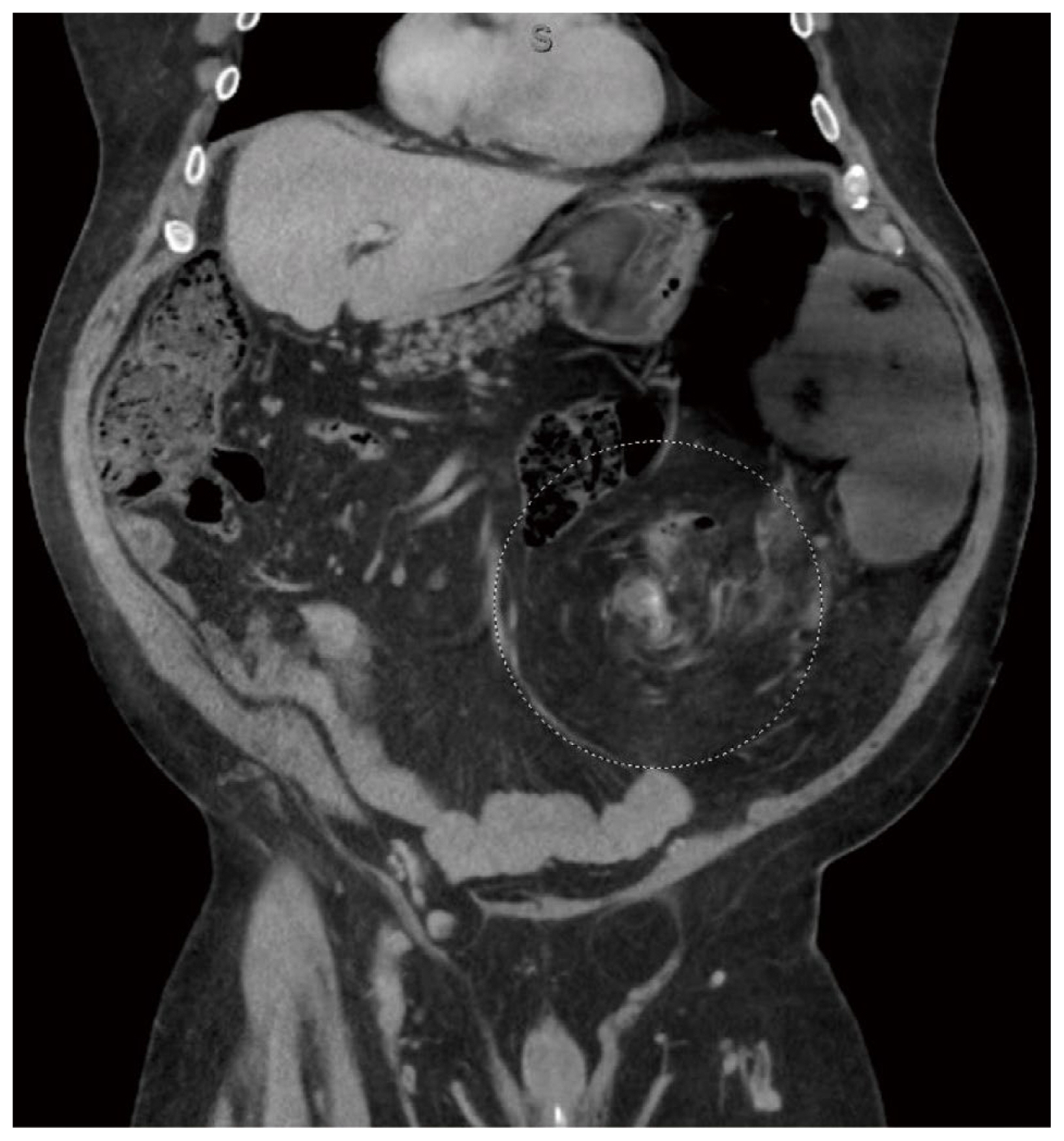
A 56-year-old man was referred from a rural clinic with a problem of bowel obstruction. He had abdominal pain and no history of abdominal surgery. There was nausea but no vomiting. He remained clinically stable, and his computerised tomography scan showed a sigmoid volvulus with no obvious signs of perforation or ischemia (Figures 1A and 1B). His abdominal examination revealed tympanic bowel with no signs of peritonitis. His biochemical and haematological profile was unremarkable. He was prepared for an emergency sigmoidoscope. Sigmoidoscopic reduction was successful in resolving the volvulus, but a cause for the obstruction could not be ascertained. He was then investigated for pseudo-obstruction of the colon (Ogilvie’s syndrome) which was negative. The patient was subsequently discharged home with a plan for an elective sigmoid colonic resection. Two weeks later he presented once more with bowel obstruction. His computerised tomography scan showed a sigmoid volvulus with a band at the rectosigmoid junction (Figure 2). The patient consented for an exploratory laparotomy with a possible Hartman’s procedure and intra-operative sigmoidoscope.
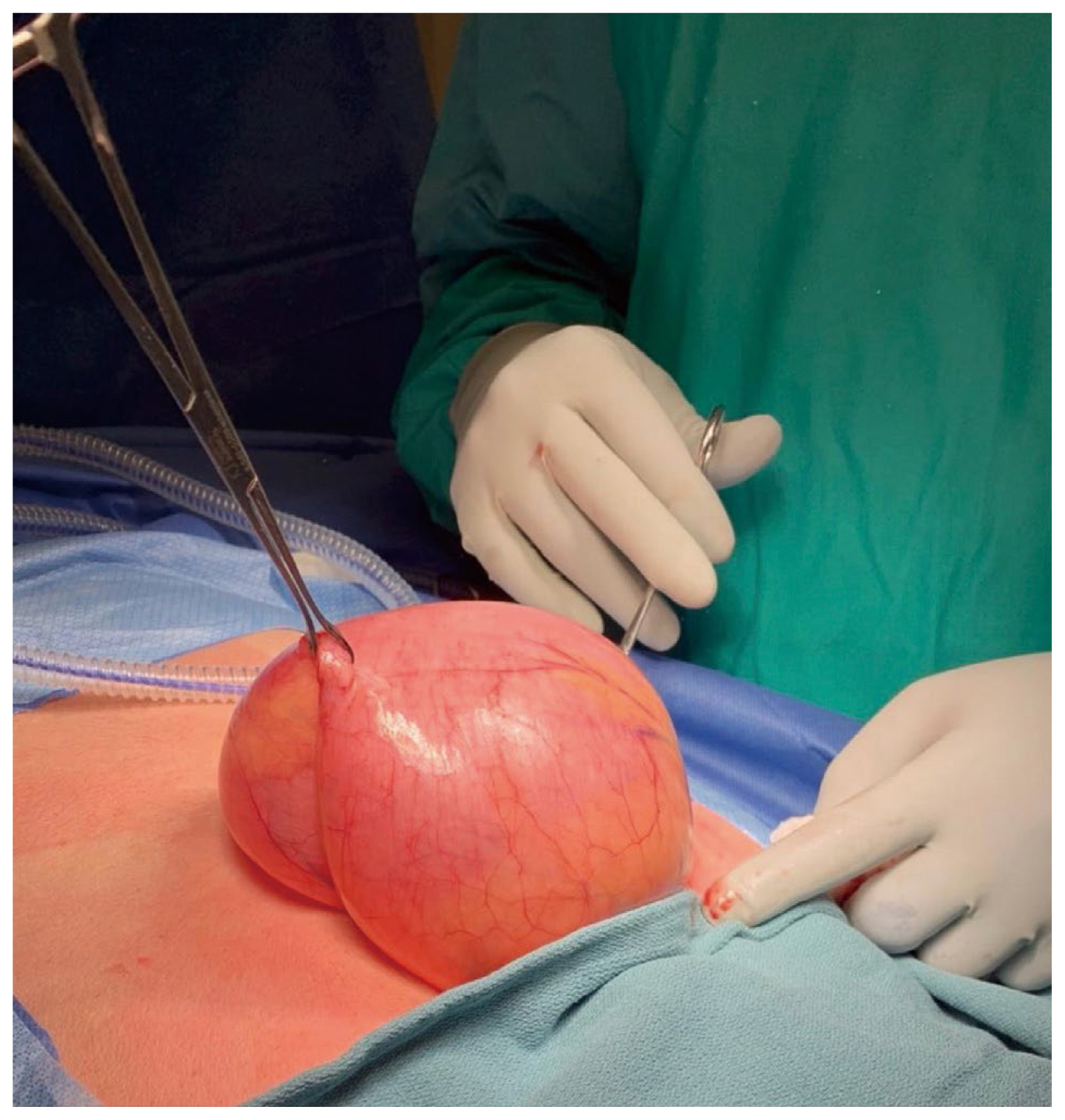
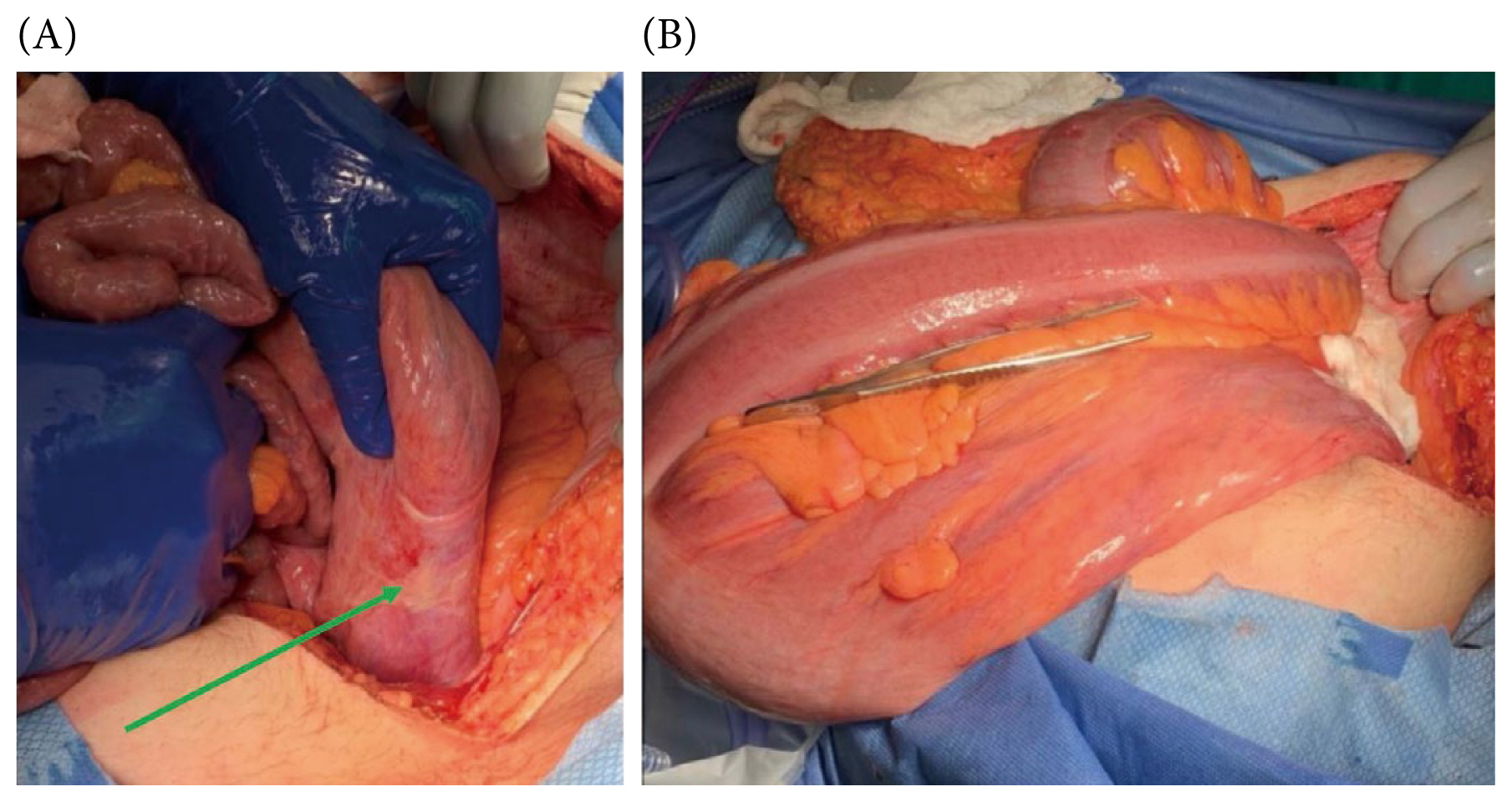
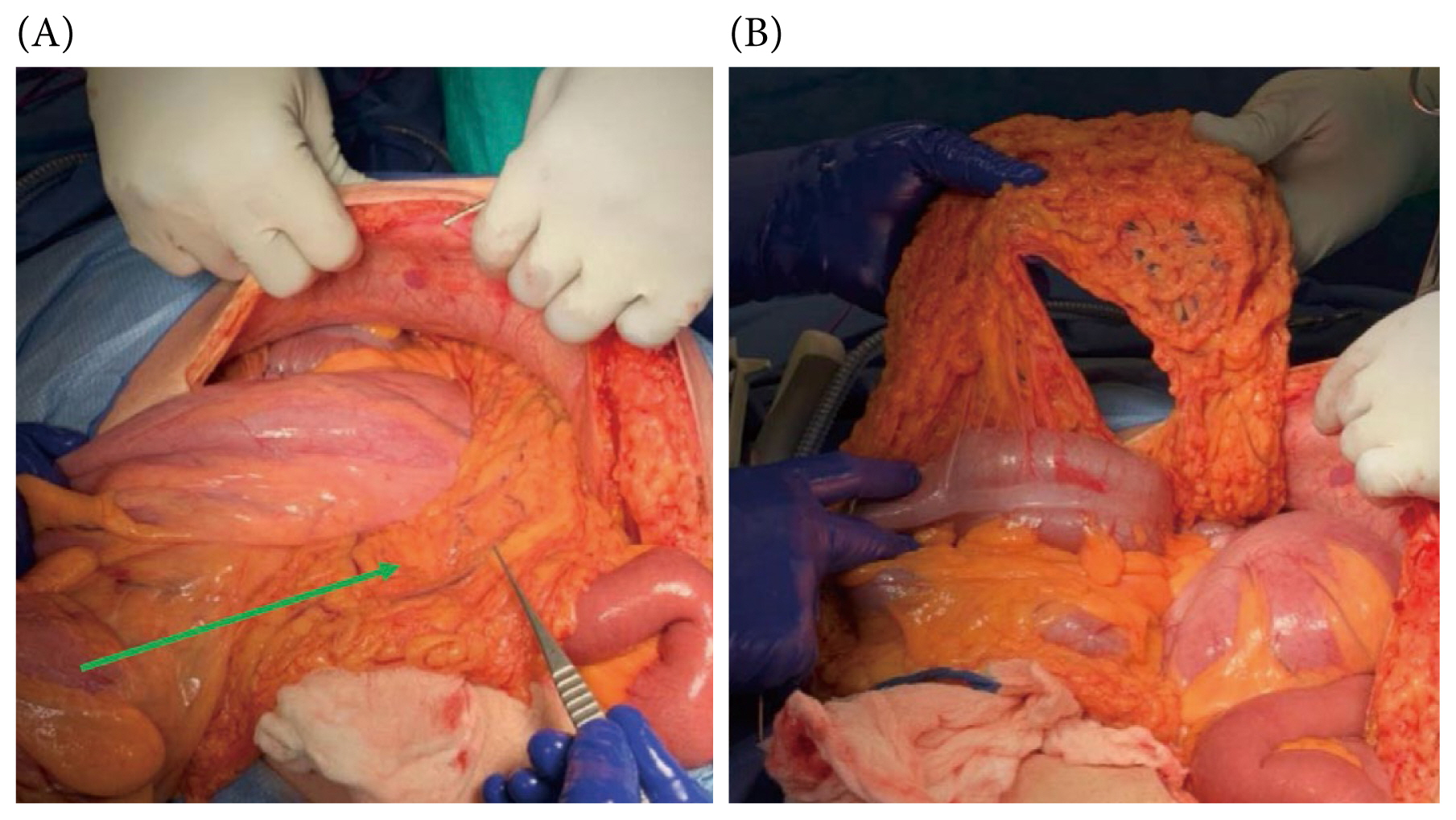
At laparotomy it was observed that the patient had a large sigmoid colon that extended to the right upper quadrant of his abdomen and over his liver (Figures 3, 4A, and 4B). The obstructing band was a congenital defect in the greater omentum (Figures 5A and 5B). This was removed and a partial omentectomy was performed. He also had a sigmoid colectomy and a Hartmann’s colostomy was created. Primary anastomosis was not attempted given the size discrepancy between the left colon and the rectum.
His recovery was challenging with a midline wound dehiscence and melaena stools passing from his colostomy. The dehiscence was thought to be attributable to his rectus diastasis and thin abdominal wall. He had a relook laparotomy and an intraoperative gastroscopy which revealed a bleeding gastric ulcer. He had secondary suturing to his abdominal wall and the dehiscence was surgically dealt with. The gastric ulcer was injected with adrenaline to affect haemostasis and he was put on H. pylori quadruple eradication therapy. A few days later the melaena stools had stopped being produced. He was able to resume his regular diet, went home after 10 days, and made an eventful recovery. Pathology confirmed regular bowel mucosa and a normal omentum with no surreptitious malignancy. His follow-up plan included a stoma reversal in 18 months.
Sigmoid volvulus remains the commonest location of a large bowel volvulus accounting for 70%–80% of cases [3,4]. The pathophysiology involves a mesenteric torsion that creates a closed loop obstruction. In most cases, the aetiology of this condition may be due to a lead point or a mass [5]. This can be intra or extra luminal. Malrotation has been implicated in a caecal volvulus but not in a sigmoid one [6]. To our knowledge this is a unique case report involving a defect in the greater omentum. The omental defect created a circumferential band as an extra luminal lead point resulting in a volvulus. Given the size of the sigmoid colon, as well as the history of the symptoms, this may well have been a congenital omental defect. Congenital trans mesenteric internal hernias, while rare, have been described as a potential source of a sigmoid volvulus [7]. There have been no published case reports to date with a congenital omental defect as a lead point in the pathophysiology of a sigmoid volvulus. This makes for a truly rare aetiology of a rare cause of large bowel obstruction. Irrespective of the aetiology, the management remains the same. Endoscopic detorsion is performed to decompress the colon in the acute phase. This is merely to affect a colonic decompression as the recurrence rate following endoscopy can be between 50%–70% [7]. Acute surgical intervention is undertaken in the presence of bowel ischemia or a failed endoscopic detorsion [8,9]. Surgery can involve a Hartmann’s colostomy or a primary anastomosis. This is the recognised standard of care for a sigmoid volvulus. Laparoscopic intervention has been reported in a few sporadic cases [10]. Surgical pexy of the sigmoid colon without a bowel resection has been attempted [7,10]. These are sporadic accounts with higher recurrence rates, morbidity, and mortality.

Author Contributions

Concept design, primary surgeon, introduction, abstract and figures: YP. Discussion and references: VN.

Conflicts of Interest

The authors declare that they have no competing interests.

Funding

No funding was provided for this article.

Ethical Statement

Informed consent was obtained from the patient.

All relevant data are included in this article.
Figure 1
(A) CT scan axial view showing the sigmoid volvulus; and (B) coronal view showing the “kidney bean” sign (orange arrow).
jacs-2024-14-1-27f1.jpg
Figure 2
Classic whorl pattern of the sigmoid colon mesentery encircled on the coronal view.
jacs-2024-14-1-27f2.jpg
Figure 3
Distended sigmoid colon upon bowel exteriorisation.
jacs-2024-14-1-27f3.jpg
Figure 4
(A) Adhesive band caused by the omental incarceration (green arrow); and (B) large sigmoid colon that extends across the patient’s abdomen post decompression.
jacs-2024-14-1-27f4.jpg
Figure 5
(A) Omentum causing the sigmoid volvulus (green arrow); and (B) the defect in the omentum once the bowel was mobilized.
jacs-2024-14-1-27f5.jpg
  • 1. Saba M, Rosenberg J, Wu G, Hinika G. A case of sigmoid volvulus in an unexpected demographic. Surg Case Rep 2021;7:13.
  • 2. Kiyaka SM, Sikakulya FK, Masereka R, Okedi XF, Anyama P. Sigmoid volvulus in an adolescent female: a case report. Int J Surg Case Rep 2021;87:106430.
  • 3. Le CK, Nahirniak P, Qaja E. [Internet]. Cecal volvulus 2022 Sep 12 StatPearls: StatPearls Publishing; 2023. Available from: https://www.ncbi.nlm.nih.gov/books/NBK470305/
  • 4. Gingold D, Murrell Z. Management of colonic volvulus. Clin Colon Rectal Surg 2012;25(4):236–44.
  • 5. Salas S, Angel CA, Salas N, Murillo C, Swischuk L. Sigmoid volvulus in children and adolescents. J Am Coll Surg 2000;190(6):717–23.
  • 6. Underhill J, Munding E, Hayden D. Acute colonic pseudo-obstruction and volvulus: pathophysiology, evaluation, and treatment. Clin Colon Rectal Surg 2021;34(4):242–50.
  • 7. Beh HN, Ongso YF, Koong DB. Transmesocolon internal hernia masking as simple sigmoid volvulus. J Surg Case Rep 2020;2020(3):rjaa017.
  • 8. Kasten KR, Marcello PW, Roberts PL, Read TE, Schoetz DJ, Hall JF, et al. What are the results of colonic volvulus surgery? Dis Colon Rectum 2015;58(5):502–7.
  • 9. Swenson BR, Kwaan MR, Burkart NE, Wang Y, Madoff RD, Rothenberger DA, et al. Colonic volvulus: presentation and management in metropolitan Minnesota, United States. Dis Colon Rectum 2012;55(4):444–9.
  • 10. Liang JT, Lai HS, Lee PH. Elective laparoscopically assisted sigmoidectomy for the sigmoid volvulus. Surg Endosc 2006;20(11):1772–3.

Figure & Data

References

    Citations

    Citations to this article as recorded by  

      Download Citation

      Download a citation file in RIS format that can be imported by all major citation management software, including EndNote, ProCite, RefWorks, and Reference Manager.

      Format:

      Include:

      A Case Report of a Rare Aetiology of a Sigmoid Volvulus Involving a Congenital Omental Defect
      J Acute Care Surg. 2024;14(1):27-29.   Published online March 21, 2024
      Download Citation
      Download a citation file in RIS format that can be imported by all major citation management software, including EndNote, ProCite, RefWorks, and Reference Manager.

      Format:
      • RIS — For EndNote, ProCite, RefWorks, and most other reference management software
      • BibTeX — For JabRef, BibDesk, and other BibTeX-specific software
      Include:
      • Citation for the content below
      A Case Report of a Rare Aetiology of a Sigmoid Volvulus Involving a Congenital Omental Defect
      J Acute Care Surg. 2024;14(1):27-29.   Published online March 21, 2024
      Close

      Figure

      • 0
      • 1
      • 2
      • 3
      • 4
      A Case Report of a Rare Aetiology of a Sigmoid Volvulus Involving a Congenital Omental Defect
      Image Image Image Image Image
      Figure 1 (A) CT scan axial view showing the sigmoid volvulus; and (B) coronal view showing the “kidney bean” sign (orange arrow).
      Figure 2 Classic whorl pattern of the sigmoid colon mesentery encircled on the coronal view.
      Figure 3 Distended sigmoid colon upon bowel exteriorisation.
      Figure 4 (A) Adhesive band caused by the omental incarceration (green arrow); and (B) large sigmoid colon that extends across the patient’s abdomen post decompression.
      Figure 5 (A) Omentum causing the sigmoid volvulus (green arrow); and (B) the defect in the omentum once the bowel was mobilized.
      A Case Report of a Rare Aetiology of a Sigmoid Volvulus Involving a Congenital Omental Defect
      TOP